Best Corporate Private Jet Membership Plans
Share this
Best Corporate Private Jet Membership Plans Based on ROI (And How to Choose the Right One)
The best corporate private jet membership plans for return on investment (ROI) are those that prioritise flexibility, avoid large capital lock-ins, and offer transparent pricing models tailored to actual flight hours rather than fixed asset ownership. Most businesses find that the highest ROI comes from on-demand or membership models that allow them to scale their travel needs without the financial burden of depreciation or heavy monthly management fees. At FlyRoving, we believe that your travel budget should go toward flying, and not toward maintaining a fleet you do not fully own.
What Defines a High-ROI Corporate Jet Membership?
When we talk about private jet membership ROI, we are looking at far more than just the price of a flight. Return on investment in business aviation covers the value of time saved, the ability to visit multiple cities in one day, and the privacy needed to conduct business while in the air. For a membership to be completely valuable, it must provide a predictable cost structure while remaining adaptable to your company's changing schedule also.

Some reports highlight that business aviation users see a 20% increase in productivity compared to those who travel via commercial airlines, and this is because teams can work in a secure environment and avoid the lengthy delays associated with major airport hubs.
Types of Private Jet Membership Plans
Choosing the right structure is the first step in making a wise financial decision for your organisation, and every model has a different impact on your balance sheet.
- Deposit-based programs
These plans require you to place a large sum of money, usually starting at £100,000 or more, into an account. As you fly, the costs are deducted from this balance, and while these business jet membership programs sometimes offer slightly lower hourly rates, they tie up capital that could be used elsewhere in your business. Note that the ROI here depends on whether the hourly savings outweigh the lost interest or investment value of that stagnant cash.
- Hourly rate memberships
Hourly memberships are very popular because they provide a fixed cost for every flight hour, and you know exactly what you will pay before take off. And yes, this predictability helps with budgeting. However, note that some providers still require an annual fee or a joining fee which can eat into the overall value if you do not fly enough hours to justify the entry cost.
- Fractional ownership
Fractional ownership involves buying a specific share of a single aircraft, and you essentially become a part-owner. This sounds prestigious, but it comes with heavy monthly management fees as well as a share of the maintenance costs as well. For most companies, the ROI on fractional ownership is low unless the aircraft is in the air for more than 200 hours a year, and the depreciation of the asset is a hidden drain on your company finances.
- On-demand charter
This is the most flexible way to fly, and you pay for each trip as you need it. There are no long-term contracts and no large deposits. While the rates can fluctuate based on market demand, the lack of fixed costs makes this a high-ROI choice for companies with irregular travel patterns.
How Companies Calculate ROI on Private Jet Memberships
How to Compare Membership Plans Based on ROI
To find the best corporate private jet membership plans, we recommend evaluating four key areas to see where the real value lies.
- Cost predictability
Does the plan offer fixed hourly rates or dynamic pricing? Fixed rates are easier for your finance team to manage, but they usually come with a higher entry price. Dynamic pricing can be cheaper during off-peak times but might surprise you during busy seasons, and we suggest looking for a middle ground where you have a clear understanding of the maximum possible cost for any given route.
- Aircraft availability
A plan has no value if there is no plane available when you need to travel, and check the guaranteed availability clauses in any contract. Some memberships require 24 hours' notice, while others might need 72 hours, and if your business moves fast, paying a bit more for short-notice access is a sensible investment.
- Time savings
Consider the locations of the airports used by the provider, and the ROI of private travel comes from using smaller, local airports that are closer to your final destination. If a membership only allows access to major hubs, you are still stuck in the same traffic as commercial passengers.
- Operational flexibility
Business needs change, and you might need a light jet for a two-person team today and a heavy jet for a ten-person executive board next month. The best private aviation membership plans allow you to swap between aircraft sizes without heavy penalties.
Hidden Costs That Reduce ROI
It is easy to be impressed by a low hourly rate, but many corporate jet card membership options have hidden fees that can quickly impact your savings.
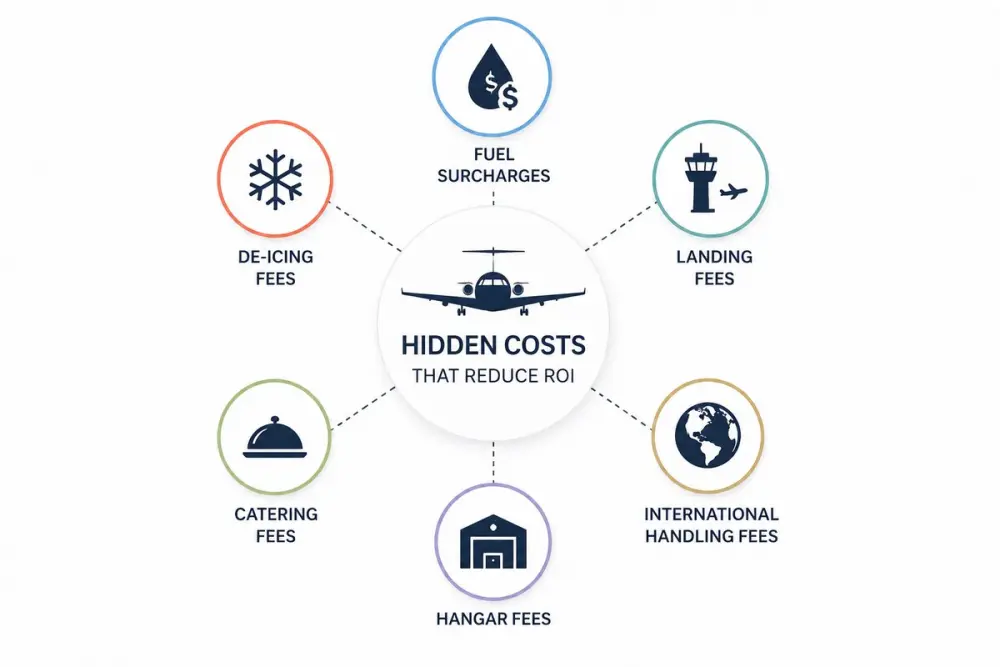 Fuel surcharges are a common addition, and as oil prices fluctuate, so does your bill. You should also look out for de-icing fees, which can cost thousands of pounds during the winter months. Some jet providers include these in the membership, while others bill them as extras. Other costs to watch for include:
- Catering fees (standard snacks vs. full meals)
- Landing fees at premium airports
- International handling fees
- Hangar fees for overnight stays
By choosing a transparent jet provider, you can avoid these surprises and also keep your ROI high.
Which Membership Model Delivers the Best ROI for Businesses?
For most modern businesses, a hybrid or on-demand model will be the best option, as the days of locking up millions of pounds in an aircraft share are fading. Today, agility is the most valuable asset a company can have, and a membership that allows you to access a global fleet without the burden of ownership provides the most direct path to a positive return.
When you use a membership that scales with you, you avoid the empty leg problem, where you pay for the aircraft to return to its home base without you on it. High-ROI plans focus on point-to-point pricing, which means you only pay for the miles you are actually in the air.
Why FlyRoving Offers a Better ROI Model
We have designed our services to fix the inefficiencies found in traditional aviation models, and we know that businesses want luxury and efficiency without the unnecessary financial baggage.
- No large capital lock-in
Different from many other corporate private jet membership plans, we focus on providing access without requiring you to park six figures in our bank account. And this no large capital lock-in keeps your capital working within your own business, where it belongs.
- Transparent pricing
No hidden surcharges. When we give you a quote, we want it to be as accurate as possible and with transparent pricing, we help you maintain a clear view of your travel spending.
- Scalable usage
Whether you fly once a month or five times a week, the FlyRoving model adapts. At FlyRoving, we provide the right aircraft for the specific mission, and this prevents the waste of flying a large jet for a short, solo trip, which is one of the quickest ways to ruin your aviation ROI.
You can learn more about how we structure our services by checking out our FlyRoving membership plans.
Choosing the Right Plan for Your Business
The right choice depends on your specific flight patterns, but flexibility is the new gold standard. To get the most out of your investment, avoid long-term commitments that do not allow for changes in aircraft size or flight frequency.
By focusing on time saved and capital preserved, you can turn private aviation from a luxury expense into a powerful business tool. FlyRoving invites you to explore how we can support your goals with a more sensible approach to private flight. Get in touch with FlyRoving for more information about our membership plans.