Bombardier Challenger 601 Charter Guide
See Bombardier Challenger 601 cabin details, range, pricing, and book with FlyRoving for business or leisure regional flights.
Share this
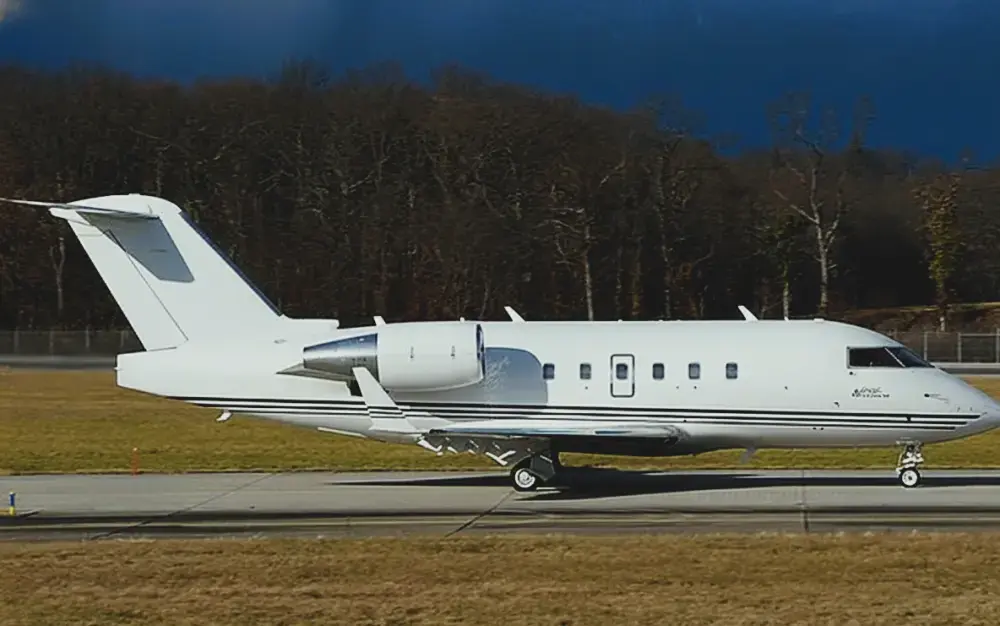
Key Points: Why Charter the Bombardier Challenger 601?
• Fly nonstop coast-to-coast or cross-Atlantic with ease.
• Spacious Cabin that can comfortably seat up to 12 passengers.
• Rear-mounted CF34 engines offer a quiet ride.
• Trusted by many operators world-wide.
The Bombardier Challenger 601 Development & Background
The Challenger 601’s story begins in 1983, when Canadair (soon to be acquired by Bombardier) sought to correct the reliability and efficiency limitations of the early Challenger 600 while retaining its wide-body comfort and long-range performance.
Challenger 601-1A (1983)
The first iteration, the 601-1A, introduced General Electric CF34-1A engines, replacing the Lycoming ALF 502Ls used in the 600. The new high-bypass engines dramatically improved thrust (8,650 lbf vs. 7,500 lbf) and fuel efficiency, while enhancing climb performance and cruise stability. Canadair also strengthened the wing and incorporated drag-reducing winglets, a first for the series, improving range by nearly 300 nautical miles.
This model was also the first Challenger to feature a glass cockpit architecture and upgraded avionics, allowing for Category II ILS approaches. Certification was achieved in September 1983, and deliveries began later that year, marking a strong step forward in reliability and operational maturity.
Challenger 601-3A (1987)
In 1987, Bombardier took over Canadair and immediately began refining the program. The 601-3A replaced the CF34-1A engines with GE CF34-3A powerplants, each producing 8,650 lbf of thrust with digital controls and improved compressor stages. This variant also introduced new avionics, including a Collins EFIS flight deck, dual FMS systems, and increased MTOW.
Cabin pressurization systems were upgraded, allowing smoother climbs to 41,000 feet while maintaining a low cabin altitude. The 601-3A became Bombardier’s first truly global business jet, operating comfortably on long-range routes such as New York – London or Los Angeles – Honolulu.
Challenger 601-3R (1993)
The 601-3R brought further refinements, focusing on increased fuel capacity and extended range. Bombardier integrated auxiliary center fuel tanks, boosting range to nearly 3,800 nautical miles, and standardized EFIS and autopilot systems from the upcoming Challenger 604.
By the time the 601-3R ended production in 1996, more than 160 aircraft had been delivered — many still flying today under private, charter, and government operation. The Challenger 601 set the stage for Bombardier’s continued dominance with the 604, 605, and 650, which evolved directly from this trusted platform.
Bombardier Challenger 601 Key Specifications
| Metric | Challenger 601-1A | Challenger 601-3A | Challenger 601-3R |
| Passenger Capacity | 9–12 | 9–12 | 9–12 |
| Crew | 2 pilots | 2 pilots | 2 pilots |
| Range | ~3,200 nm (5,926 km) | ~3,500 nm (6,482 km) | ~3,800 nm (7,038 km) |
| Max Cruise Speed | Mach 0.80 / 460 KTAS | Mach 0.82 / 470 KTAS | Mach 0.82 / 470 KTAS |
| Service Ceiling | 41,000 ft | 41,000 ft | 41,000 ft |
| Takeoff Distance (MTOW) | ~5,400 ft / 1,646 m | ~5,400 ft / 1,646 m | ~5,500 ft / 1,646 m |
| Landing Distance | ~2,600 ft / 792 m | ~2,600 ft / 792 m | ~2,600 ft / 792 m |
| Cabin Dimensions (L × W × H) | 28 ft × 8.2 ft × 6.1 ft (8.6 m × 2.5 m × 1.85 m) | 28 ft × 8.2 ft × 6.1 ft (8.6 m × 2.5 m × 1.85 m) | 28 ft × 8.2 ft × 6.1 ft (8.6 m × 2.5 m × 1.85 m) |
| Cabin Volume | 1,146 cu ft / 32.5 m³ | 1,146 cu ft / 32.5 m³ | 1,146 cu ft / 32.5 m³ |
| Engines | 2 × GE CF34-1A | 2 × GE CF34-3A | 2 × GE CF34-3R |
| Thrust per Engine | 8,650 lbf | 8,850 lbf | 8,850 lbf |
| Max Takeoff Weight (MTOW) | 43,000 lb / 19,505 kg | 43,000 lb / 19,505 kg | 44,000 lb / 19,958 kg |
Bombardier Challenger 601 Cabin Experience
The Challenger 601 preserved the wide, flat-floor cabin layout that defined the series, measuring 8.2 feet wide, 6.1 feet high, and 28 feet long. Most configurations feature double-club seating, a three-person divan, forward galley, and fully enclosed lavatory.
Noise suppression improved significantly from the 600 series, thanks to better insulation and redesigned engine pylons. Today, modernized interiors often feature Wi-Fi, touch-screen cabin management systems, and leather-appointed seating rivaling more recent jets.
Bombardier Challenger 601 Operating Costs & Market Insight (2025)
| Metric | Challenger 601 |
| Direct Operating Cost | ~$5,200–$5,800/hr |
| Charter Rate | ~$9,000–$10,500/hr |
| Fuel Burn | ~320 GPH |
| Maintenance Programs | SmartParts, JSSI |
| Average Used Value (2025) | $2.5M – $3.4M USD |
Bombardier Challenger 601 One-Way Charter Pricing Estimates for 2025
Approximate Bombardier Challenger 601 all-inclusive one-way charter rates (subject to seasonal demand, fuel prices, and repositioning):
Actual pricing will vary with fuel costs, seasonal demand, and aircraft repositioning needs.
Charter a Bombardier Challenger 601 From New York (TEB / JFK)
• New York → Miami: $30,000 – $34,000 — ~2h 45m – 3h 10m
• New York → Chicago: $23,000 – $26,000 — ~2h 00m – 2h 20m
• New York → Dallas: $34,000 – $38,000 — ~3h 05m – 3h 30m
• New York → Los Angeles: $58,000 – $65,000 — ~5h 00m – 5h 30m
Charter a Bombardier Challenger 601 From Los Angeles (LAX / VNY)
• Los Angeles → Las Vegas: $11,000 – $14,000 — ~55m – 1h 15m
• Los Angeles → San Francisco: $18,000 – $22,000 — ~1h 20m – 1h 45m
• Los Angeles → New York: $58,000 – $65,000 — ~4h 55m – 5h 25m
• Los Angeles → Chicago: $42,000 – $48,000 — ~3h 45m – 4h 10m
Charter a Bombardier Challenger 601 From Miami (MIA / OPF)
• Miami → New York: $30,000 – $34,000 — ~2h 45m – 3h 10m
• Miami → Dallas: $32,000 – $36,000 — ~2h 50m – 3h 10m
• Miami → Los Angeles: $60,000 – $68,000 — ~4h 50m – 5h 20m
• Miami → Chicago: $34,000 – $39,000 — ~3h 00m – 3h 20m
Charter a Bombardier Challenger 601 From Chicago (ORD / MDW)
• Chicago → Dallas: $23,000 – $27,000 — ~1h 55m – 2h 15m
• Chicago → New York: $23,000 – $26,000 — ~2h 00m – 2h 20m
• Chicago → Aspen: $28,000 – $33,000 — ~2h 20m – 2h 40m
• Chicago → Miami: $34,000 – $39,000 — ~3h 00m – 3h 20m
Charter a Bombardier Challenger 601 From Dallas (DAL / DFW)
• Dallas → Houston: $11,000 – $14,000 — ~50m – 1h 10m
• Dallas → Los Angeles: $36,000 – $42,000 — ~3h 10m – 3h 30m
• Dallas → New York: $34,000 – $38,000 — ~3h 05m – 3h 30m
• Dallas → Chicago: $23,000 – $27,000 — ~1h 55m – 2h 15m
Charter a Bombardier Challenger 601 From San Francisco (SFO / SQL)
• San Francisco → Los Angeles: $18,000 – $22,000 — ~1h 20m – 1h 45m
• San Francisco → Seattle: $22,000 – $26,000 — ~1h 50m – 2h 10m
• San Francisco → Chicago: $48,000 – $55,000 — ~4h 00m – 4h 30m
• San Francisco → New York: $60,000 – $68,000 — ~5h 10m – 5h 40m
Bombardier Challenger 601 Aircraft Capabilities & Performance
The Bombardier Challenger 601 is equipped with two General Electric CF34 engines that produce between 8,650lbs to 8,850lbs of thrust. With the help of the aerodynamics and engine, the Challenger 601 has a range between 3,200-3,800nm depending on the variant, a max cruise speed of Mach 0.82 (470KTAS/870km/h), a service ceiling of 41,000ft, and a fuel burn of 320 gallons per hour. The Challenger 601 has a moderate takeoff distance of 5,400 ft and a landing distance of 2,600ft, making it accessible at most regional airports.
The pilots are given Honeywell SPZ-8000 avionics with the dual EFIS and FMS, but the later variants host the standard Collins Pro Line 4 suite. As this is a two pilot aircraft, captains are usually hired around 4000TT, and first officers around 2000TT.
Bombardier Challenger 601 Booking Process with FlyRoving
Flying with FlyRoving is straightforward:
• Request a Quote: Submit a flight request online at FlyRoving.com or call our 24/7 concierge.
• Review Options: Receive tailored quotes with aircraft details, photos, and pricing.
• Confirm & Pay: Choose your preferred aircraft and secure your itinerary online.
• Fly: Arrive at a private terminal for hassle-free boarding and enjoy a seamless journey.
FlyRoving provides personalized service, competitive pricing, and transparent terms.